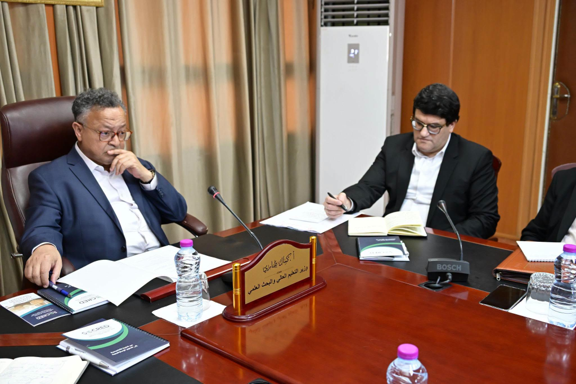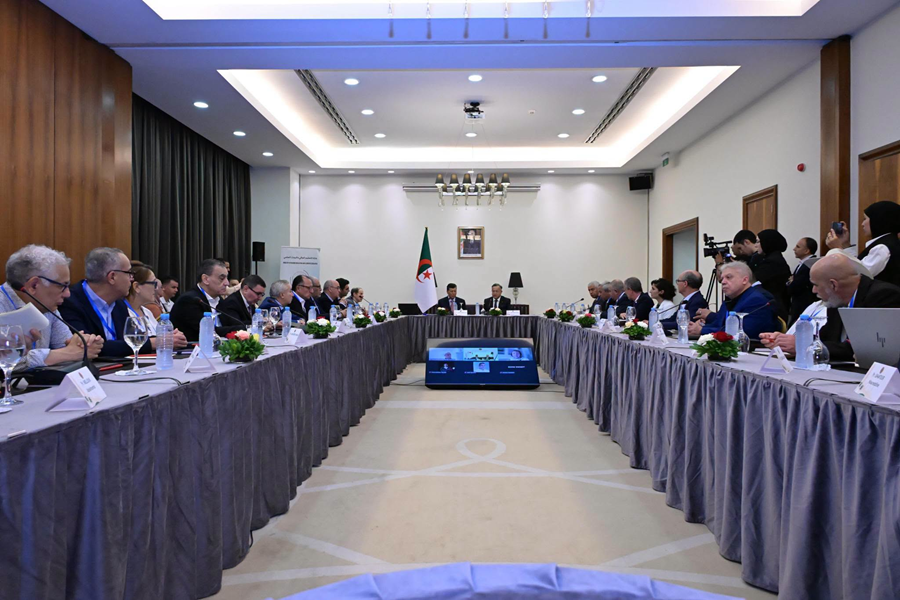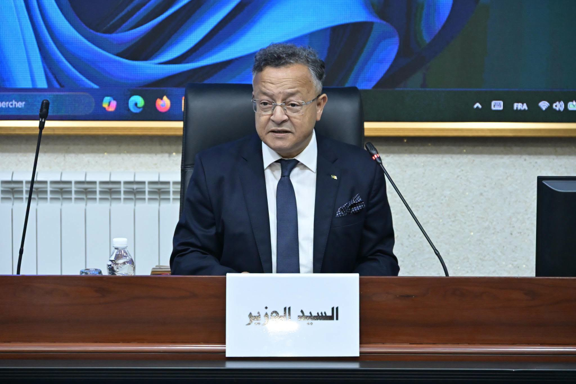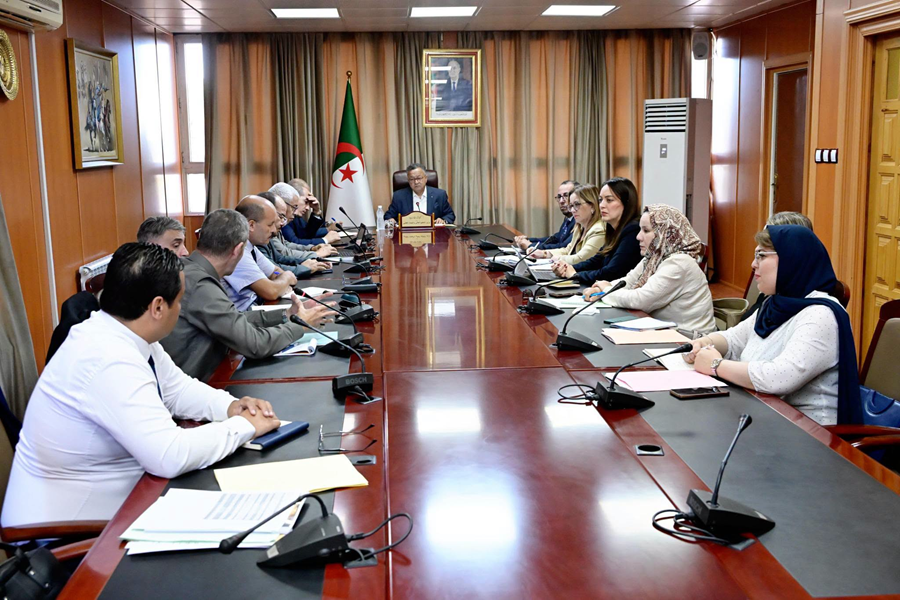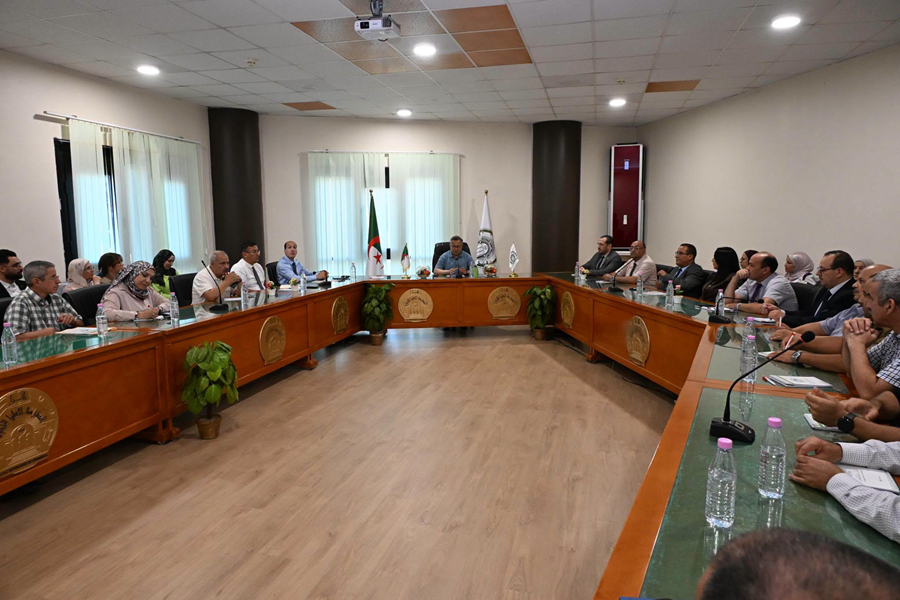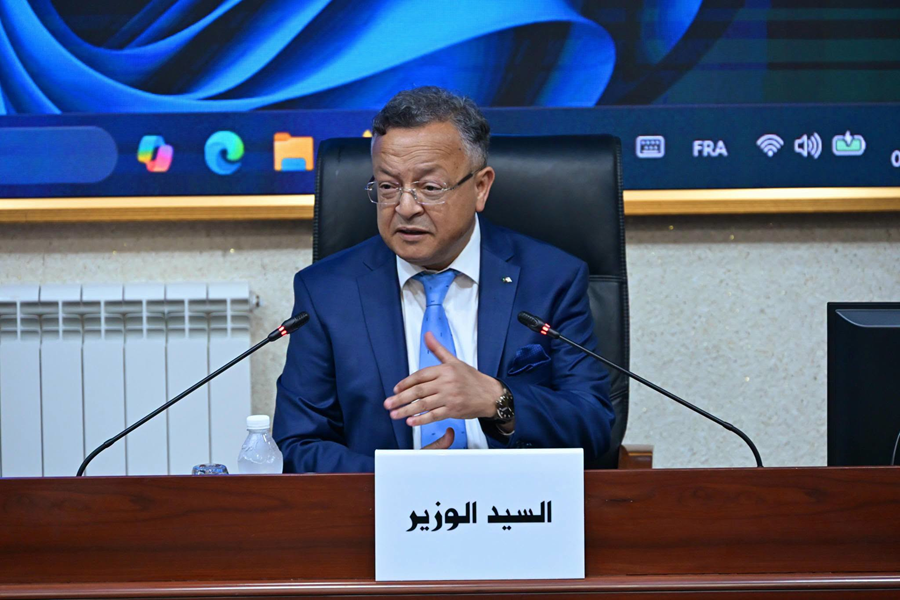
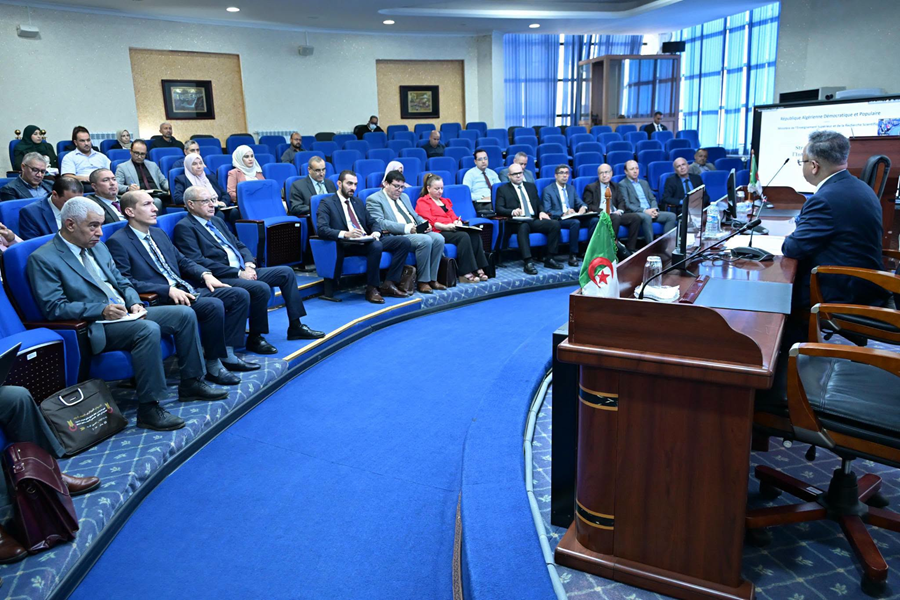
Minister of Higher Education and Scientific Research chairs the first coordination meeting on the implementation of the National Artificial Intelligence Strategy
ministerial activities

Minister of Higher Education and Scientific Research chairs the first coordination meeting on the implementation of the National Artificial Intelligence Strategy

The Minister of Higher Education and Scientific Research, Mr. Kamel Baddari, chaired, on Tuesday, September 8, 2026, the first coordination meeting with representatives of several ministerial departments, dedicated to monitoring and implementing the National Artificial Intelligence Strategy and translating its main pillars into concrete programs and projects with tangible impact.
The meeting resulted in a number of decisions and measures, most notably:
– The establishment of five thematic committees responsible for following up on the main pillars of the National Artificial Intelligence Strategy:
• Data and Infrastructure Committee;
• Financing Committee;
• Large Language Models Committee;
• Specialized PhD Committee in Artificial Intelligence;
• Continuing Education Committee in Artificial Intelligence.
– The establishment of a National Research Center for Artificial Intelligence and Data, aimed at strengthening national capacities in research, development and technological innovation.
– The programming of short-term technological projects, including:
• The development of an AI-based tax administration and management system;
• The establishment of a multisectoral Algerian system aimed at promoting and facilitating the widespread use of artificial intelligence tools.
– The training of 50,000 specialists in artificial intelligence by 2030, in response to the growing needs of the national economy and labor market.
– Preparation for the launch of artificial intelligence research projects under the National Research Programs (PNR), in line with national priorities and the needs of the various sectors.
These decisions are part of efforts to strengthen intersectoral coordination and national capacities in artificial intelligence, thereby supporting the digital transformation and promoting the use of technology, scientific research and innovation in the service of national development.

Minister of Higher Education and Scientific Research Chairs Remote Meeting to Review Preparations for the New Academic Year

ministerial activities

Minister of Higher Education and Scientific Research Chairs Remote Meeting to Review Preparations for the New Academic Year

The Minister of Higher Education and Scientific Research, Mr. Kamel Baddari, opened the remote meeting held on the afternoon of Wednesday, September 2, 2026, with the recitation of Al-Fatiha and a minute of silence in memory of the victims of the recent wildfires.

The meeting, which brought together the directors of higher education institutions and university services, was devoted to monitoring and assessing the sector’s level of preparedness and reviewing the latest preparations ahead of the upcoming academic year.

The meeting provided an opportunity to review progress on several priority areas, notably:

  • Renovation and rehabilitation works in university residences, including the rehabilitation of 2,233 pavilions nationwide during this summer.
  • Academic organization and teaching programs, to ensure that institutions are fully prepared to welcome students.
  • Strengthening coordination and cooperation between higher education institutions and university services.
  • Boosting the economic activity of university economic subsidiaries and enhancing their contribution to the wider economic environment.

In this regard, the Minister instructed the directors of higher education institutions to carry out comprehensive field inspections of all university residences, building by building and room by room, in order to verify their readiness and ensure the best possible reception and accommodation conditions for students from the very first day of the new academic year. He stressed the importance of collective mobilization and concerted efforts by all stakeholders to ensure the success of this important milestone.

The Minister also called on the directors of higher education institutions to strengthen and develop the economic and commercial activities of their affiliated subsidiaries, thereby reinforcing the university’s role as a creator of added value and a partner in supporting the national economic dynamic.

At the end of the meeting, the Minister reaffirmed the sector’s continued commitment to improving students’ living and study conditions and to enhancing the quality of university services provided to them across higher education institutions and university residences throughout the country.

Minister of Higher Education and Scientific Research Chairs Joint Meeting on Integrating Students of Schools and Institutes under the Tutorship of the Ministry of Culture and Arts into the “PROGRES” System

ministerial activities

Minister of Higher Education and Scientific Research Chairs Joint Meeting on Integrating Students of Schools and Institutes under the Tutorship of the Ministry of Culture and Arts into the “PROGRES” System

Minister of Higher Education and Scientific Research, Mr. Kamel Baddari, chaired today, Tuesday, September 1, 2026, at the Ministry’s headquarters, a joint working meeting bringing together the Higher Education and Scientific Research and Culture and Arts sectors, in the presence of officials from both ministries.

The meeting was devoted to examining the practical and technical mechanisms for integrating students of the five schools and institutes under the supervision of the Culture and Arts sector into the integrated information system “PROGRES” and enabling them to benefit from various university services.

Ministerial Meetings

ministerial activities

Ministerial Meetings

The Minister of Higher Education and Scientific Research, Mr. Kamel Baddari, chaired a coordination meeting on the afternoon of 11 August 2026 at the Ministry’s headquarters to assess the readiness of university service structures and services ahead of the upcoming academic year.
The meeting was attended by Ministry officials, the official in charge of managing the Directorate General of the National Office of University Services, the directors of university services in Algiers, as well as the official responsible for digitalization at the Office.

Mr. Kamel Baddari Sets Development Priorities for Houari Boumediene University of Science and Technology: Rehabilitation, Quality and Scientific Excellence

activités ministérielles

Mr. Kamel Baddari Sets Development Priorities for Houari Boumediene University of Science and Technology: Rehabilitation, Quality and Scientific Excellence

The Minister of Higher Education and Scientific Research, Mr. Kamel Baddari, held a working meeting on the evening of 2 August 2026 with the administrative and academic staff of the Houari Boumediene University of Science and Technology (USTHB).
The meeting focused on several strategic areas aimed at developing the university and strengthening its position as a leading national scientific institution. The main areas discussed included:


• Assessing the rehabilitation and maintenance works of the university’s facilities, which form part of the architectural heritage designed by the renowned international architect Oscar Niemeyer, while ensuring the preservation of their architectural identity and providing a suitable learning environment for the entire university community.
• Preparing for the upcoming academic year, by assessing the readiness of the university’s facilities and ensuring the availability of all the necessary material and educational requirements for a successful start to the new academic year.
• Strengthening the quality of teaching and scientific research, with the aim of improving the university’s academic performance and consolidating its leading position at both the national and international levels.

Minister of Higher Education and Scientific Research Announces 2026 Baccalaureate Orientation Results: 97% of Students Assigned According to Their Preferences

activités ministérielles

Minister of Higher Education and Scientific Research Announces 2026 Baccalaureate Orientation Results: 97% of Students Assigned According to Their Preferences

The Minister of Higher Education and Scientific Research, Mr. Kamel Baddari, held a press conference today, 30 July 2026, at the Ministry’s headquarters, during which he announced the results of the university orientation process for 2026 baccalaureate holders.


The Minister stated that the university orientation process was conducted 100% digitally, within an integrated system aimed at strengthening the principles of transparency and equal opportunities among all newly admitted baccalaureate holders. A total of 391,018 students were assigned to programs, with 97% receiving one of their preferred choices. The process was based on balancing students’ preferences, the admission capacities of higher education institutions, and labor market needs.


These results reflect the success of the modern digital system adopted by the sector, which has been enhanced with artificial intelligence technologies, including a smart assistant designed to support students throughout the orientation process, as well as modern data analysis tools.


More than 227,000 students (60%) were oriented towards science, technology and mathematics programs, compared with more than 163,000 students (40%) in the fields of literature, humanities and social sciences. In addition, 2,400 students were oriented towards emerging and future-oriented fields, including artificial intelligence, robotics and nanotechnology.


Furthermore, 46,500 students (12%) benefited from direct employment opportunities, through their orientation to Higher Teacher Training Schools and paramedical training institutes.

Ministerial Meetings

activités ministérielles

Ministerial Meetings

The Minister of Higher Education and Scientific Research, Mr. Kamel Baddari, met on the evening of 26 July 2026, at the Ministry’s headquarters, with researcher and expert Mr. Mourad Bouzit, a professor at Qingdao University in Shandong Province, China, with the aim of launching a project for the design and development of final prototypes ready for industrial manufacturing in the field of robotics, including:
• A four-legged and six-legged robotic dog;
• A humanoid robot;
• An intelligent delivery robot.
The project will involve students from the National Higher School of Mathematics, the National Higher School of Artificial Intelligence, and the National Higher School of Autonomous Systems, under the “Chahid Abdelhafid Ihaddadene” Scientific and Technological Hub in Sidi Abdallah, as well as the Centre for Development of Advanced Technologies (CDTA).
A specialised robotics technology platform is also planned at the “Chahid Abdelhafid Ihaddadene” Scientific and Technological Hub in Sidi Abdallah, with the aim of strengthening training, research and innovation capacities in robotics, artificial intelligence and advanced technologies.

National University conference: A New Roadmap to Consolidate the Smart University, Strengthen Innovation and Create Wealth

activités ministérielles

National University conference: A New Roadmap to Consolidate the Smart University, Strengthen Innovation and Create Wealth

The Minister of Higher Education and Scientific Research, Mr. Kamel Baddari, chaired the National University Conference today, July 25, 2026. The conference was attended by senior officials from the central administration, presidents of regional conferences, directors of university institutions, directors of national organizations, as well as representatives of students and social partners in the sector.
In his opening address, the Minister affirmed that the Algerian university has entered a new phase, defined by the smart university, the entrepreneurial university, and the university as a producer of knowledge and wealth, in implementation of the orientations of the President of the Republic aimed at building a knowledge-based economy and strengthening scientific and technological sovereignty.
During the cpnference, the roadmap for the new academic year was presented. It includes a number of major structural projects, notably:
• The launch of a personalized educational pathway for students, supported by artificial intelligence technologies, through the introduction of a smart assistant that will guide students in selecting their courses according to their skills, interests, and academic and professional objectives, thereby enabling them to build a training pathway tailored to their ambitions and abilities.
• The development of a Large Language Model (LLM) for university professors, enabling them to automatically prepare exercises and educational activities, while also using artificial intelligence technologies to assess students’ answers. This will contribute to improving the quality of education and keeping pace with the latest teaching practices.
• As part of strengthening the university’s economic role, the Minister announced that the sector aims to bring 5,000 innovative Algerian products to the national market by 2030, under the slogan “Made in Algeria.” Each product is expected to lead to the creation of a startup, a micro-enterprise, or a spin-off, thereby transforming the university into a hub for production, innovation, and wealth creation.
• The second edition of the “Proto Market” programme was also announced. It will focus on supporting the development of technological prototypes, with funding ranging from one million (DZD 1,000,000) to two million (DZD 2,000,000) for students, enabling them to complete their final prototypes and obtain the “Startup” label.
• In the field of innovative project financing, the Minister confirmed the establishment of the first venture capital investment company at the University of Algiers 3, as well as the launch of Algeria’s first Venture Capital Mutual Fund (FCPR), with plans to establish four additional funds before the end of the year, in order to provide sustainable financing mechanisms for innovative student projects.
• The Minister also highlighted that Algerian universities are undertaking, for the first time, the process of obtaining the ISO 9001:2015 international quality certification. Five university institutions have already obtained the certification in the fields of education and scientific research, reflecting the sector’s commitment to promoting a culture of quality and continuous improvement.
• In the area of international engagement, the Minister called for increased efforts to improve the visibility of Algerian universities in international rankings, in light of the positive results achieved in recent years, and to further strengthen their scientific and academic presence internationally.
• The results of the university twinning programme were also presented, with a total of 77 twinning agreements, alongside the encouraging results achieved by the “Study in Algeria” platform, which has attracted 1,500 new international students from 34 countries. This contributes to enhancing the international standing of Algerian universities and generating significant foreign-currency revenues for the national economy.
• In the field of university services, significant progress has been recorded in improving students’ accommodation conditions, with 2,283 accommodation units renovated out of a total of 3,283. In addition, financial savings estimated at several billion dinars per month have been achieved since April through the digitalisation of catering services. This has directly contributed to rationalising expenditure, improving the quality of meals, and enhancing the quality of accommodation services provided to students.

Minister’s Meetings

Departemental activities

Minister's Meetings

The Minister of Higher Education and Scientific Research, Mr. Kamel Baddari, chaired, on the evening of 16 July 2026, at the Ministry’s headquarters, a preparatory meeting for the National Conference of Universities, scheduled to be held at the end of this month, in the presence of the Ministry’s central executives.
The meeting was devoted to preparations for this important national event. During the session, a committee was appointed to prepare and finalize the conference agenda, with the aim of ensuring its effective organization and identifying the key issues and priority topics to be discussed, as part of the ongoing efforts to further develop Algeria’s higher education and scientific research system.

The Minister of Higher Education and Scientific Research electronically signs the ministerial circular regarding the guidance of new Bachelor’s degree graduates for the 2026 session: towards a digital and smart university that creates the jobs of tomorrow.

departmental activities

The Minister of Higher Education and Scientific Research electronically signs the ministerial circular regarding the guidance of new Bachelor’s degree graduates for the 2026 session: towards a digital and smart university that creates the jobs of tomorrow.

The Minister of Higher Education and Scientific Research, Mr. Kamel Baddari, officially launched the 2026 Baccalaureate Holders’ Orientation and Registration Guide on 7 July 2026 at the Ministry’s headquarters. In a new format, the circular reflects the sector’s vision aimed at building a digital, open, intelligent university that creates the professions of tomorrow, by consolidating digital transformation and modernizing the orientation and training system in order to meet the requirements of development and technological changes.
During a press conference devoted to presenting the content of Ministerial Circular No. 01 on the orientation and registration of 2026 baccalaureate holders, as well as the key features of the upcoming academic year, the Minister explained that the guide has been fully digitalised as an interactive online platform, enabling students to access all university orientation information and services easily and efficiently.
He announced that all registration procedures, whether academic or administrative, will be conducted exclusively online starting 15 July 2026, through dedicated digital platforms accessible via computers and smartphones, eliminating the need for physical attendance. A dedicated application will also be launched to allow new students to calculate their weighted average according to university admission criteria.
As part of the smart orientation initiative, the guide incorporates, for the first time, a Large Language Model (LLM) powered by artificial intelligence within the digital orientation platform. This feature enables students to ask questions and receive instant, personalised responses around the clock. In addition, data mining technologies will be used to analyse students’ preferences and optimise the orientation process. The number of programme choices available to applicants has also been increased from 10 to 12, providing greater flexibility in selecting academic pathways.
Regarding the development of academic programmes, the Minister announced the introduction of 13 new specialisations aligned with future professions, including a State Engineering programme in Artificial Intelligence, as part of the national objective of training 30,000 AI specialists by 2030. Other newly introduced programmes include an Integrated Master’s in Quantum Technologies, a Master’s in Information Systems Interoperability, and a Master’s in Space Systems Mechanics.
In coordination with the Ministry of Health, several new programmes in medicine and health sciences have also been introduced, including a Bachelor’s degree in Oral Health and Dental Hygiene, Master’s programmes in Genetic Counselling, Medical Artificial Intelligence, Medical Bioinformatics, and Addiction Studies, the opening of a Pharmacy programme at the University of Saïda, accreditation of a Master’s programme in Anaesthesia, and the creation of a Postgraduate Diploma in Precision Medicine.
The upcoming academic year will also strengthen programmes promoting national identity through the introduction of a programme in Information and Communication Sciences taught in the Amazigh language, specialising in audiovisual studies. Furthermore, the international dimension of higher education will be reinforced through six new programmes established under twinning agreements and partnerships with foreign universities, enhancing the national and international recognition of Algerian university degrees.
The Minister also announced several additional measures, including the enrolment of 35,000 new students in Higher Teacher Training Schools with direct employment contracts, the introduction of the Lean Start-up module into academic curricula, the upgrading of seven medical annexes into full faculties, increasing the total number of medical faculties to 21, the generalisation of the courses History of Algeria and Citizenship and Patriotism across all fields of study, and the integration of higher education institutions under the Ministry of Culture and Arts into the PROGRES digital information system.
In conclusion, Mr. Kamel Baddari reviewed the achievements of the previous academic year, which included the online launch of the National Qualifications Framework, the graduation—for the first time in the history of Algerian higher education—of a cohort of students who completed their entire academic journey without using paper, as well as the graduation of the first cohorts from the National Higher School of Mathematics and the National Higher School of Artificial Intelligence. These achievements demonstrate the rapid modernisation of Algerian higher education and reinforce its position as a digital, innovative, and internationally oriented university system.