
Minister’s Meetings

activités ministérielles

Minister’s Meetings
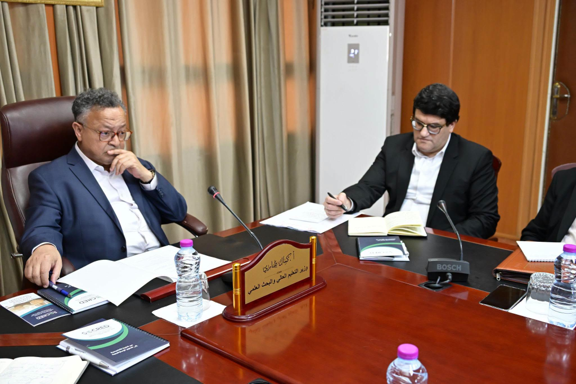
The Minister of Higher Education and Scientific Research, Mr. Kamel Baddari, chaired a coordination meeting with ministry officials on the evening of Sunday, 11 October 2026, in the presence of the rectors of the University of Algiers 3 and the University of Blida 1. The meeting focused on monitoring the progress of the 2026–2027 academic year and reviewing developments in the sector’s priority programmes, projects and policy matters.
The meeting addressed several strategic and organizational areas, including:
1. Academic Year and Education: Monitoring the effective commencement of classes, ensuring compliance with the prescribed semester teaching hours, expanding English-language instruction, developing individualized study pathways, and following up on the dual-degree training project in medicine and the bachelor’s degree programme taught in English.
2. University Services and Student Life: Reviewing cleanliness standards in university residences, transport and accommodation conditions, improving students’ living environment, and monitoring rehabilitation programmes for university residences.
3. Infrastructure and New Projects: Monitoring budgets allocated to the rehabilitation of university residences, projects involving new infrastructure and medical faculties, and development and refurbishment programmes for university institutions. Discussions also covered the introduction of new activity headings in the budget classification and the rehabilitation project for the University of Health in Algiers.
4. Innovation and Entrepreneurship: Following up on existing and new projects under the “ProtoMarket” initiative, business creation projects, the development of university-affiliated company subsidiaries, and measures to promote innovation and entrepreneurship. The meeting also reviewed the integration of financing and stock-market investment mechanisms.
5. Digital Transformation and Artificial Intelligence: Monitoring progress on the artificial intelligence project and the development of the second version of the “PROGRES” information system, while ensuring consistency and alignment of figures and indicators across the relevant departments and institutions.
6. Attracting International Students and Strengthening International Cooperation: Reviewing the situation of international students and their reception arrangements, including transportation from airports to university institutions. Discussions also addressed the development of the “Study in Algeria” programme, international cooperation initiatives and partnership projects.
7. Governance and Human Resources: Following up on draft regulatory texts, recruitment procedures for medical sciences lecturers and teacher-researchers, the updating of recruitment criteria, and the management of assets transferred to the higher education sector, alongside evaluation and valorization matters.
8. Budget and Future Programmes: Reviewing the proposed budget for 2027, identifying the financial requirements associated with new programmes, and monitoring construction and development projects scheduled for the 2026–2027 academic year.
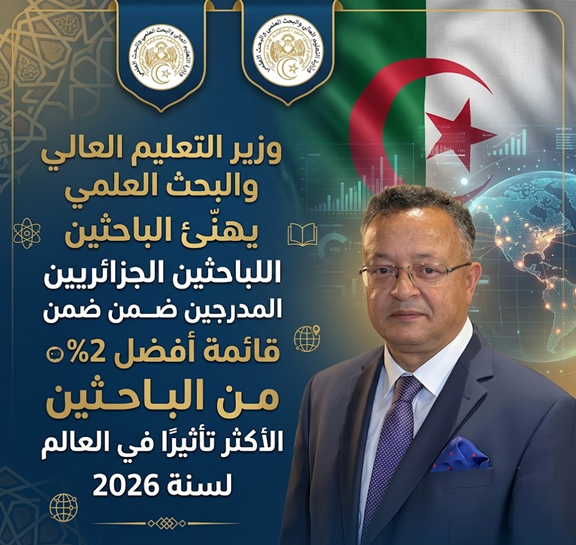
Minister of Higher Education and Scientific Research Congratulates Algerian Researchers Named Among the World’s Top 2% Most Influential Scientists in 2026

activités ministérielles

Minister of Higher Education and Scientific Research Congratulates Algerian Researchers Named Among the World’s Top 2% Most Influential Scientists in 2026

The Minister of Higher Education and Scientific Research, Mr. Kamel Baddari, congratulated the Algerian academic and research community in a post published on his official social media account, following the inclusion of a number of Algerian researchers in the Stanford–Elsevier list of the world’s top 2% most influential scientists for 2026. This achievement reflects the growing presence of national scientific talent on the international research scene.

The congratulatory message reads as follows:

“I extend my congratulations to the Algerian academic and research community on this outstanding scientific achievement, marked by the inclusion of a number of our researchers in the Stanford–Elsevier list of the world’s top 2% most influential scientists for 2026.

This progress is reflected in the increase in the number of Algerian researchers included in the career-long scientific impact list, from 38 to 45 researchers, including four ranked among the top ten in the Maghreb. In the annual scientific impact list, their number has risen from 80 to 101 researchers, including five ranked among the top ten in the Maghreb.

These achievements highlight the wealth of scientific talent within our universities and their capacity to contribute to knowledge production and expand the horizons of innovation.

While recognizing this well-deserved distinction, we reaffirm our commitment to continuing our efforts to strengthen the position of Algerian universities within the international scientific community, enhance their research profile and make knowledge a driving force for national development and the shaping of the future.

Congratulations to our distinguished researchers. I wish them continued success and further achievements in the service of science and the nation.”

ProtoMarket 2: Funding 937 Innovative Projects to Promote Innovation and Entrepreneurship in Higher Education

activités ministérielles

ProtoMarket 2: Funding 937 Innovative Projects to Promote Innovation and Entrepreneurship in Higher Education

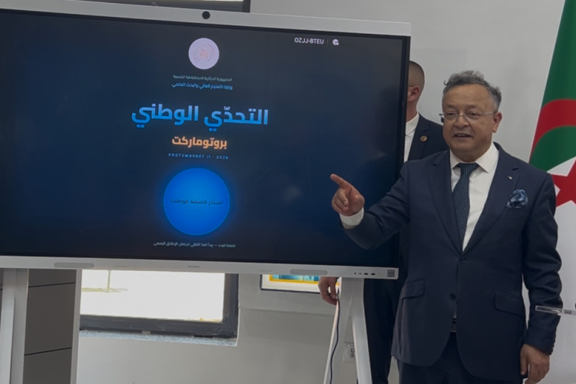
In a significant step towards promoting innovation and fostering an entrepreneurial culture within the university environment, the final deliberations of the second edition of the national challenge “ProtoMarket 2” resulted in the selection of 937 innovative projects for funding, out of a total of 2,110 applications submitted through the national platform. The total funding envelope amounts to DZD 1,188,400,000, with an estimated average of approximately DZD 1.27 million per project.
This initiative forms part of the efforts undertaken by the Ministry of Higher Education and Scientific Research to harness the innovative potential of students, graduates and doctoral students, and to support them in turning their creative ideas into prototypes that can be further developed, commercialized and economically valorized. It also aims to enhance the technological value of products emerging from universities and encourage the creation of start-ups, thereby helping transform knowledge and scientific research into innovative economic projects while opening up new opportunities for wealth creation and national development.
At the regional level, the selected projects are distributed across the country’s three regions. The Eastern region leads with 333 projects, followed by the Central region with 317 projects and the Western region with 287 projects.
This distribution reflects the broadening scope of participation and the growing momentum of innovation and entrepreneurship across national higher education institutions. It also highlights the diversity of the university innovation ecosystem and the increasing number of initiatives aimed at transforming creative ideas into projects with economic and technological value.
In terms of technological fields, the selected projects cover eight major areas. Digital applications and platforms rank first, with 314 projects, followed by artificial intelligence-based applications and platforms with 171 projects, electronic equipment and devices with 146 projects, and connected solutions and the Internet of Things (IoT) with 136 projects.
The selected projects also cover biological and food products; materials, chemistry and manufactured products; pharmaceutical, cosmetic and healthcare products; as well as services and training.
This diversity highlights the expanding scope of innovation within universities and the wide range of fields in which university talent applies scientific knowledge and technical expertise to develop innovative solutions that address economic and social needs. It also strengthens opportunities for technological valorization and the economic development of promising ideas and projects.
In terms of supervision and support, the results involve 98 university institutions out of 117 targeted university incubators. This reflects the broad reach of support and mentoring mechanisms designed for innovative projects and strengthens their prospects of progressing from the idea stage to practical implementation.
These results reaffirm the central role of university incubators as strategic platforms for hosting innovative initiatives, guiding project holders through the various stages of development, and enhancing their technological maturity, ultimately leading to the development of prototypes with potential for economic valorization and commercialization.
This momentum reflects the direction of Algerian universities towards fostering a culture of innovation and initiative, while strengthening the integration of education, scientific research and the requirements of economic and social development. It also demonstrates their commitment to transforming knowledge and creativity into added value by encouraging start-up creation, supporting a knowledge- and technology-based economy, contributing to wealth creation, and promoting sustainable national development.
As a reminder, ProtoMarket is a national mechanism designed to support and finance the development of innovative ideas into prototypes, paving the way for their further development into products suitable for manufacturing and commercialization. It therefore helps strengthen opportunities for valorizing university innovations and transforming them into projects with economic value, while encouraging start-up creation and fostering an entrepreneurial culture within the university environment.