
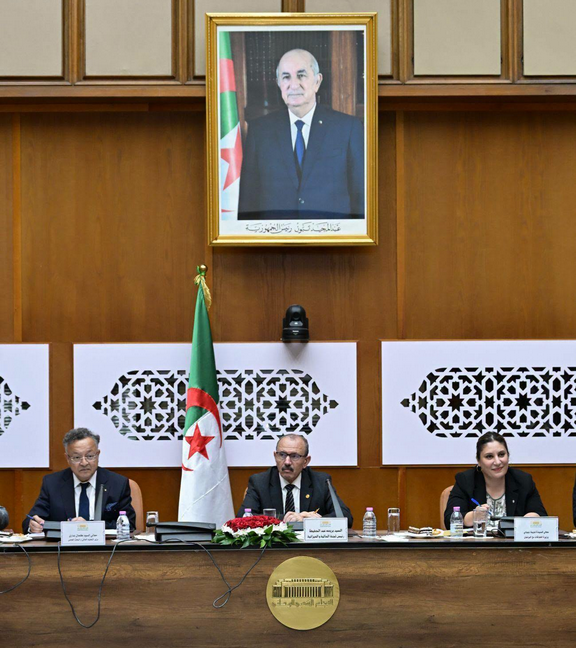
The Minister of Higher Education and Scientific Research, Mr. Kamel Baddari, presented an overview of the proposed budget for his sector under the 2027 Finance Bill on Saturday afternoon, 17 October 2026, at the headquarters of the People’s National Assembly (APN). The presentation was delivered before members of the Assembly’s Finance and Budget Committee, in the presence of Ms. Nadjiba Djilali, Minister of Relations with Parliament.
At the opening of the proceedings, the Committee Chair emphasized that the examination of sectoral budgets goes beyond assessing the financial allocations provided. It also involves evaluating whether these allocations address actual priorities and are used effectively to improve sector performance. With regard to higher education and scientific research, he stressed the importance of consolidating the university’s role as a hub for knowledge production, skills development and innovation, in line with the needs of the national economy.
In his address, Mr. Kamel Baddari presented the proposed budget for his sector, amounting to DZD 843.81 billion in commitment authorizations, representing an increase of 8.25%, and DZD 847.26 billion in payment appropriations.
He also highlighted the sector’s main achievements and recent developments, noting that the academic year had witnessed comprehensive digitalization covering a total student population of 1.84 million. He further stated that 79% of training programmes were directed towards science, technology and the professions of the future.
During his presentation, the Minister highlighted several key achievements and initiatives, including:
• Development of infrastructure and academic specializations: Establishment of the National Higher School of Optics and Engineering in Sétif, alongside the introduction of new specializations in medicine and health sciences in coordination with the Ministry of Health.
• Modernization of training programmes: Introduction of seven new dual-degree programmes across five universities and launch of the electronic version of the Algerian Framework of Qualifications and Certifications in Higher Education, developed in coordination with the various ministerial sectors.
• Enhancement of scientific research: Introduction of a new mechanism allowing doctoral theses to be submitted in the form of a coherent collection of scientific works, with a view to enhancing the recognition and value of researchers’ scientific output.
• Strengthening international openness: Attraction of 334 international students from 39 different nationalities and launch of the second edition of the “Study in Algeria” programme.
• Promotion of quality assurance: Continued support for universities seeking quality certification and expansion of the “Fourth-Generation University” model.
• Strengthening ties with Algerian scientific talent abroad: Establishment of an institutional framework for the Algerian scientific community abroad and creation of a higher advisory council attached to the President of the Republic.
• Support for innovation and entrepreneurship: Promotion of strategic innovative projects and presentation of 80 products, alongside the acquisition of the first national accreditation in the field of training on unmanned aerial vehicle (drone) systems.
Following the presentation, members of the Committee were given the opportunity to raise their concerns and submit comments on various issues relating to the management and development of the sector. The main issues discussed included:
• Improving university services: Addressing pressure on accommodation capacity in university residences and easing transport constraints by opening new routes, particularly in major cities, to facilitate student mobility.
• Modernizing university catering: Accelerating the digitalization of catering services to improve their management and ensure the provision of complete and balanced meals.
• Enhancing the quality of university education: Strengthening the quality of higher education and moving away from a predominantly quantitative approach towards a greater focus on the quality of training and its outcomes, thereby improving graduates’ skills and competencies.
• Improving faculty working conditions: Providing staff housing for university teachers and modernizing and equipping scientific laboratories to meet teaching and research requirements.
• Supporting national talent and innovation: Addressing the brain drain, strengthening support for innovative projects, supporting business incubators and promoting university-based entrepreneurship.
These discussions form part of the review of the sector’s proposed budget for 2027 and aim to assess budgetary priorities and their contribution to improving the quality of university education, strengthening scientific research and innovation, and enhancing services provided to the university community.