Minister’s Meetings

activités ministérielles

Minister’s Meetings
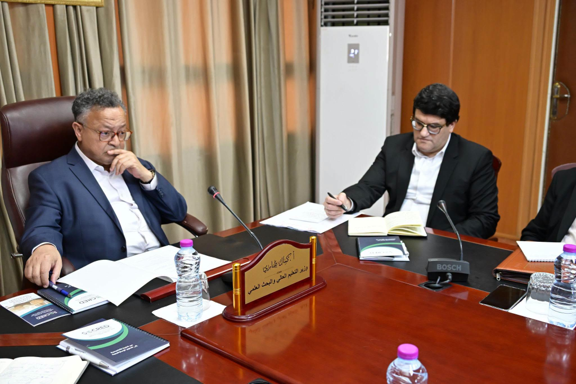
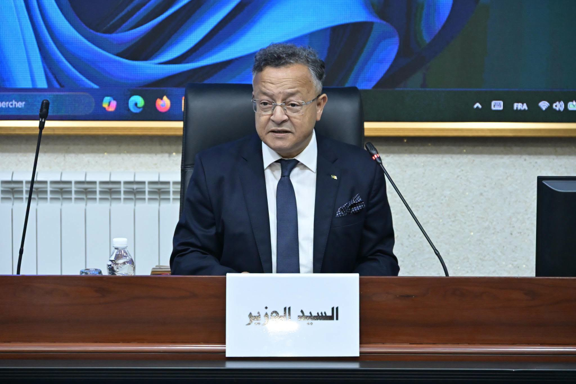
The Minister of Higher Education and Scientific Research, Mr. Kamel Baddari, chaired a coordination meeting with ministry officials on the evening of Sunday, 11 October 2026, in the presence of the rectors of the University of Algiers 3 and the University of Blida 1. The meeting focused on monitoring the progress of the 2026–2027 academic year and reviewing developments in the sector’s priority programmes, projects and policy matters.
The meeting addressed several strategic and organizational areas, including:
1. Academic Year and Education: Monitoring the effective commencement of classes, ensuring compliance with the prescribed semester teaching hours, expanding English-language instruction, developing individualized study pathways, and following up on the dual-degree training project in medicine and the bachelor’s degree programme taught in English.
2. University Services and Student Life: Reviewing cleanliness standards in university residences, transport and accommodation conditions, improving students’ living environment, and monitoring rehabilitation programmes for university residences.
3. Infrastructure and New Projects: Monitoring budgets allocated to the rehabilitation of university residences, projects involving new infrastructure and medical faculties, and development and refurbishment programmes for university institutions. Discussions also covered the introduction of new activity headings in the budget classification and the rehabilitation project for the University of Health in Algiers.
4. Innovation and Entrepreneurship: Following up on existing and new projects under the “ProtoMarket” initiative, business creation projects, the development of university-affiliated company subsidiaries, and measures to promote innovation and entrepreneurship. The meeting also reviewed the integration of financing and stock-market investment mechanisms.
5. Digital Transformation and Artificial Intelligence: Monitoring progress on the artificial intelligence project and the development of the second version of the “PROGRES” information system, while ensuring consistency and alignment of figures and indicators across the relevant departments and institutions.
6. Attracting International Students and Strengthening International Cooperation: Reviewing the situation of international students and their reception arrangements, including transportation from airports to university institutions. Discussions also addressed the development of the “Study in Algeria” programme, international cooperation initiatives and partnership projects.
7. Governance and Human Resources: Following up on draft regulatory texts, recruitment procedures for medical sciences lecturers and teacher-researchers, the updating of recruitment criteria, and the management of assets transferred to the higher education sector, alongside evaluation and valorization matters.
8. Budget and Future Programmes: Reviewing the proposed budget for 2027, identifying the financial requirements associated with new programmes, and monitoring construction and development projects scheduled for the 2026–2027 academic year.
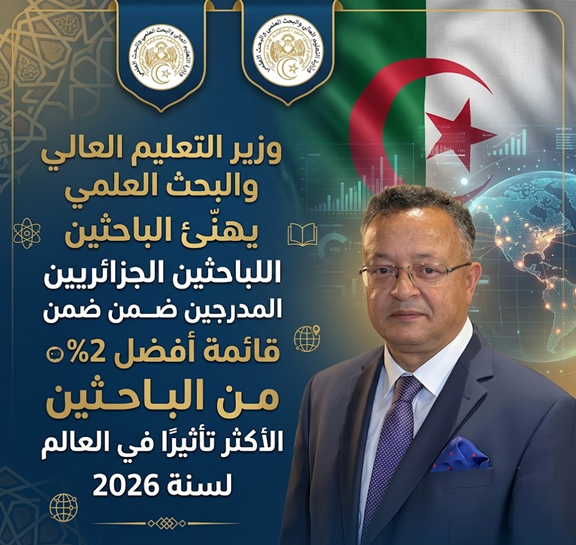
Minister of Higher Education and Scientific Research Congratulates Algerian Researchers Named Among the World’s Top 2% Most Influential Scientists in 2026

activités ministérielles

Minister of Higher Education and Scientific Research Congratulates Algerian Researchers Named Among the World’s Top 2% Most Influential Scientists in 2026

The Minister of Higher Education and Scientific Research, Mr. Kamel Baddari, congratulated the Algerian academic and research community in a post published on his official social media account, following the inclusion of a number of Algerian researchers in the Stanford–Elsevier list of the world’s top 2% most influential scientists for 2026. This achievement reflects the growing presence of national scientific talent on the international research scene.

The congratulatory message reads as follows:

“I extend my congratulations to the Algerian academic and research community on this outstanding scientific achievement, marked by the inclusion of a number of our researchers in the Stanford–Elsevier list of the world’s top 2% most influential scientists for 2026.

This progress is reflected in the increase in the number of Algerian researchers included in the career-long scientific impact list, from 38 to 45 researchers, including four ranked among the top ten in the Maghreb. In the annual scientific impact list, their number has risen from 80 to 101 researchers, including five ranked among the top ten in the Maghreb.

These achievements highlight the wealth of scientific talent within our universities and their capacity to contribute to knowledge production and expand the horizons of innovation.

While recognizing this well-deserved distinction, we reaffirm our commitment to continuing our efforts to strengthen the position of Algerian universities within the international scientific community, enhance their research profile and make knowledge a driving force for national development and the shaping of the future.

Congratulations to our distinguished researchers. I wish them continued success and further achievements in the service of science and the nation.”

ProtoMarket 2: Funding 937 Innovative Projects to Promote Innovation and Entrepreneurship in Higher Education

activités ministérielles

ProtoMarket 2: Funding 937 Innovative Projects to Promote Innovation and Entrepreneurship in Higher Education

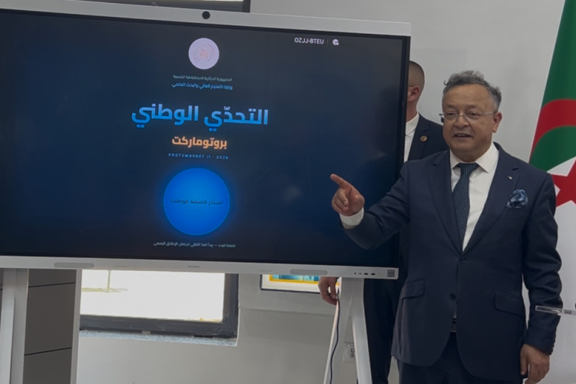
In a significant step towards promoting innovation and fostering an entrepreneurial culture within the university environment, the final deliberations of the second edition of the national challenge “ProtoMarket 2” resulted in the selection of 937 innovative projects for funding, out of a total of 2,110 applications submitted through the national platform. The total funding envelope amounts to DZD 1,188,400,000, with an estimated average of approximately DZD 1.27 million per project.
This initiative forms part of the efforts undertaken by the Ministry of Higher Education and Scientific Research to harness the innovative potential of students, graduates and doctoral students, and to support them in turning their creative ideas into prototypes that can be further developed, commercialized and economically valorized. It also aims to enhance the technological value of products emerging from universities and encourage the creation of start-ups, thereby helping transform knowledge and scientific research into innovative economic projects while opening up new opportunities for wealth creation and national development.
At the regional level, the selected projects are distributed across the country’s three regions. The Eastern region leads with 333 projects, followed by the Central region with 317 projects and the Western region with 287 projects.
This distribution reflects the broadening scope of participation and the growing momentum of innovation and entrepreneurship across national higher education institutions. It also highlights the diversity of the university innovation ecosystem and the increasing number of initiatives aimed at transforming creative ideas into projects with economic and technological value.
In terms of technological fields, the selected projects cover eight major areas. Digital applications and platforms rank first, with 314 projects, followed by artificial intelligence-based applications and platforms with 171 projects, electronic equipment and devices with 146 projects, and connected solutions and the Internet of Things (IoT) with 136 projects.
The selected projects also cover biological and food products; materials, chemistry and manufactured products; pharmaceutical, cosmetic and healthcare products; as well as services and training.
This diversity highlights the expanding scope of innovation within universities and the wide range of fields in which university talent applies scientific knowledge and technical expertise to develop innovative solutions that address economic and social needs. It also strengthens opportunities for technological valorization and the economic development of promising ideas and projects.
In terms of supervision and support, the results involve 98 university institutions out of 117 targeted university incubators. This reflects the broad reach of support and mentoring mechanisms designed for innovative projects and strengthens their prospects of progressing from the idea stage to practical implementation.
These results reaffirm the central role of university incubators as strategic platforms for hosting innovative initiatives, guiding project holders through the various stages of development, and enhancing their technological maturity, ultimately leading to the development of prototypes with potential for economic valorization and commercialization.
This momentum reflects the direction of Algerian universities towards fostering a culture of innovation and initiative, while strengthening the integration of education, scientific research and the requirements of economic and social development. It also demonstrates their commitment to transforming knowledge and creativity into added value by encouraging start-up creation, supporting a knowledge- and technology-based economy, contributing to wealth creation, and promoting sustainable national development.
As a reminder, ProtoMarket is a national mechanism designed to support and finance the development of innovative ideas into prototypes, paving the way for their further development into products suitable for manufacturing and commercialization. It therefore helps strengthen opportunities for valorizing university innovations and transforming them into projects with economic value, while encouraging start-up creation and fostering an entrepreneurial culture within the university environment.

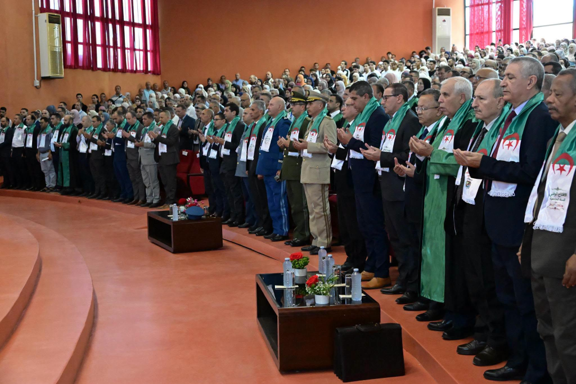
From Jijel, Mr. Kamel Baddari presides over the opening of the 2026-2027 academic year… A new year marked by renewal, innovation and shaping the future

activités ministérielles

From Jijel, Mr. Kamel Baddari presides over the opening of the 2026-2027 academic year… A new year marked by renewal, innovation and shaping the future

The Minister of Higher Education and Scientific Research, Mr. Kamel Baddari, today presided over the official opening ceremony of the 2026-2027 academic year at “Seddik Ben Yahia” University of Jijel, in the presence of local authorities, the university community, professors, researchers and students.

The choice of Jijel Province to host the opening ceremony carries particular national and humanitarian significance, given the difficult circumstances the region experienced this summer as a result of the wildfires.

The presence of the Minister of Higher Education and Scientific Research at Jijel University thus conveyed a message of solidarity and support to the people of the province, while reaffirming the State’s commitment to supporting all regions of the country and strengthening the role of the university as a beacon of knowledge, hope and future-building.

In his address on the occasion, Mr. Baddari affirmed that the Algerian university is entering the new academic year with a vision focused on enhancing the quality of education and training, developing scientific research, accelerating digital transformation, harnessing artificial intelligence, promoting innovation and entrepreneurship, and strengthening the university’s engagement with its economic and social environment.

In his address, the Minister highlighted several key areas:

  1. The student at the heart of university transformation

Mr. Baddari emphasized that students remain at the heart of the various reforms undertaken in the higher education and scientific research sector, stressing that the modern university’s mission goes beyond awarding degrees. It is fundamentally about educating students who possess knowledge, skills, initiative and the ability to develop solutions.

In this context, Algerian universities are moving towards consolidating the concept of the Empowerment University, based on fostering a culture of initiative, encouraging the creation of startups and micro-enterprises, promoting the valorization of scientific research outcomes, and transforming ideas and innovations into projects, products and services with added value.

  1. A digital university and artificial intelligence at the service of students

The 2026-2027 academic year is marked by the continued expansion of digitalization and the development of university and educational services, helping bring services closer to students, simplify procedures and improve the quality of student support.

Artificial intelligence also represents one of the emerging pillars in the development of the Algerian university, through its use in education and training, scientific research, academic guidance, as well as in improving the performance of university administration and services, in line with the implementation of the National Artificial Intelligence Strategy.

  1. A university open to its environment

Mr. Baddari stressed the need to further strengthen the university’s openness to its economic and social environment and to transform knowledge and scientific research into practical tools that contribute to local and national development.

  1. Improving student living conditions

The Minister of Higher Education and Scientific Research also affirmed that improving students’ living conditions and support remains a priority, through the continued rehabilitation of university residences, the improvement of catering and accommodation services, stronger hygiene and security standards, and the provision of suitable spaces for sports and cultural activities.

He stressed that the quality of university services is an integral part of the quality of the university itself, and that students should find within the university an environment conducive to learning, creativity, excellence and the development of their academic and professional careers.

From “Seddik Ben Yahia” University of Jijel, the 2026-2027 academic year thus begins with a clear message: the Algerian university is continuing its process of transformation and modernization, placing students at the heart of its priorities and putting innovation, scientific research and digitalization at the service of development.

It thereby reaffirms its role as a space for knowledge and learning, a nursery for skills and competencies, and an active partner in shaping Algeria’s future.

Minister of Higher Education and Scientific Research Chairs the Third Multisectoral Meeting to Follow Up on the Implementation of the National Artificial Intelligence Strategy

activités ministérielles

Minister of Higher Education and Scientific Research Chairs the Third Multisectoral Meeting to Follow Up on the Implementation of the National Artificial Intelligence Strategy

Minister of Higher Education and Scientific Research, Mr. Kamel Baddari, chaired, on Monday, September 21, 2026, the third multisectoral meeting dedicated to monitoring the implementation of the National Artificial Intelligence Strategy, in the presence of representatives of the various relevant sectoral committees. The meeting was held as part of the transition from the planning phase to the effective implementation of the strategy’s priority areas and projects.

The meeting focused on reviewing the progress made in preparing the sectoral financial estimates required to cover the operations scheduled under the strategy’s implementation roadmap, as well as examining the progress achieved by the various specialized committees.

Data and Infrastructure Committee

The committee identified 17 infrastructure-related operations and 14 data-related operations for 2026. These include the use of available servers and Graphics Processing Units (GPUs), as well as identifying future infrastructure and equipment requirements needed to host and deploy artificial intelligence applications.

The committee also proposed establishing a cluster bringing together public and private economic enterprises, with a view to strengthening synergies between national technological and economic capabilities.

In this context, the updated version of the draft decree establishing the National Research Center for Artificial Intelligence and Data was approved, with instructions to refer it to the relevant authorities for completion of the legal procedures.

Financing Committee

The committee presented various potential sources and mechanisms for financing projects and operations related to the implementation of the strategy, including public funding, the establishment of a national fund, bank financing mechanisms, and international funding, as well as contributions from private enterprises and the Algerian community abroad. It also examined the potential use of economic and financial revenues generated by artificial intelligence applications.

Large Language Models (LLM) Committee

An update was presented on the development of four large language models: two have been completed, while two others are currently under development. These include a prototype Chatbot specialized in Algerian tax legislation, as well as another model intended for students enrolled in the personalized academic pathway.

Artificial Intelligence PhD Committee

The proposed PhD training areas were presented. The admission competition is scheduled for November 2026 and includes 24 theoretical and applied areas, aimed at addressing priority issues and topics identified by the various sectors.

Artificial Intelligence Continuing Training Committee

The committee identified 85 training operations aimed at developing human-resource skills across different sectors through specialized and targeted training programs in artificial intelligence and its applications.

International Cooperation Committee on Artificial Intelligence Applications

The institutional frameworks and various international initiatives in which Algeria participates in the field of artificial intelligence were identified. Priority areas for leveraging these initiatives in support of national objectives were also defined.

Thematic Research Network on Artificial Intelligence

It was confirmed that the operations included in the National Artificial Intelligence Strategy will be addressed through the National Research Projects (PNR) and the Thematic Research Network on Artificial Intelligence, starting in October 2026.

This meeting reflects the effective transition of the National Artificial Intelligence Strategy into the implementation phase, through the launch of its priority projects and the translation of its strategic areas into concrete programs and operations, thereby strengthening the use of artificial intelligence in support of development and innovation.

Minister of Higher Education and Scientific Research receives top-performing 2026 baccalaureate graduates

activités ministérielles

Minister of Higher Education and Scientific Research receives top-performing 2026 baccalaureate graduates

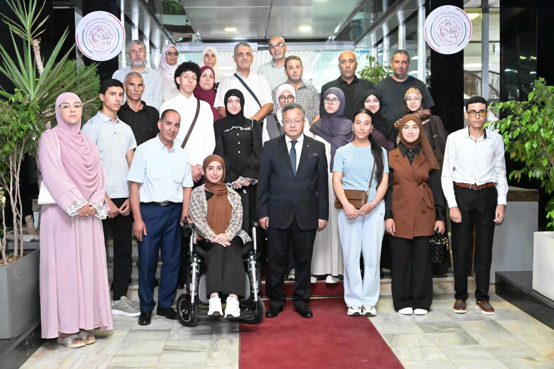
The Minister of Higher Education and Scientific Research, Mr. Kamel Baddari, received, on the afternoon of September 20, 2026, at the Ministry’s headquarters, twelve (12) top-performing students who obtained their baccalaureate in the 2026 session, in recognition of their excellence and to celebrate their outstanding academic results.
Six (06) of the top-performing students will travel to England, under the Algerian State scholarship program, to pursue their university studies, while the other six (06) have chosen to continue their studies at Algerian universities and higher schools.
On this occasion, the Ministry extends its sincere congratulations to all the outstanding students and wishes them continued success and excellence throughout their university and academic careers, both in Algeria and abroad. May their achievements inspire them to pursue further excellence and innovation and to contribute to the service of their country.

Algeria to host the 13th African University Games in Oran in 2028

Actualités

Algeria to host the 13th African University Games in Oran in 2028

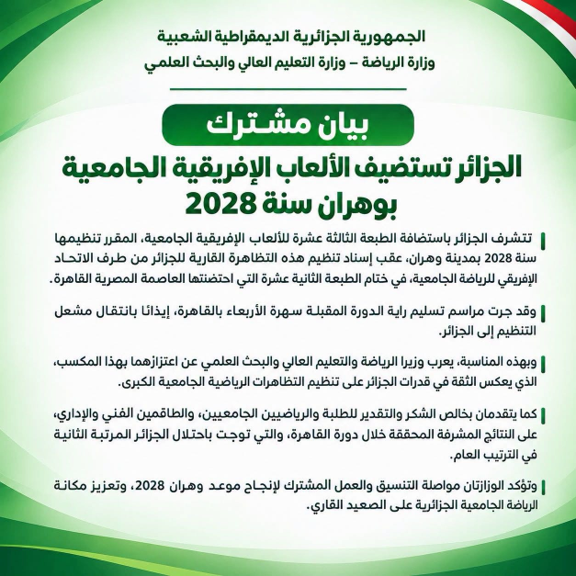
In a joint announcement by the Ministry of Higher Education and Scientific Research and the Ministry of Sports, Algeria has been selected to host the 13th edition of the African University Games, scheduled to take place in the city of Oran in 2028.


Algeria was selected to host this continental event from among several candidate countries following the conclusion of the 12th edition of the African University Games, held in Cairo, Egypt. The selection reflects the momentum of Algerian university sport and the results achieved during Algeria’s participation in the event. Algeria won 115 medals, including 41 gold medals, ranking second at the continental level in terms of the total number of medals won.


In 2028, the city of Oran will therefore welcome university student-athletes from various African countries for an event bringing together sporting competition, university and cultural exchange, while providing an opportunity to strengthen communication and ties among African university youth.
Hosting the African University Games represents a new milestone in strengthening Algeria’s presence in university sport at the continental level. It will also provide the city of Oran with an opportunity to showcase its capacity to host and organize major sporting events.


Thus, Algerian university sport is moving from the medal podium in Cairo to the organizational stage in Oran, reflecting the growing presence of Algerian universities and their youth in African events, while further strengthening their openness and engagement with the continent.

Minister of Higher Education and Scientific Research inspects Bab Ezzouar 3 University Residence (CUB3)

activités ministérielles

Minister of Higher Education and Scientific Research inspects Bab Ezzouar 3 University Residence (CUB3)

As part of the field monitoring of preparations for the 2026–2027 academic year, the Minister of Higher Education and Scientific Research, Mr. Kamel Baddari, conducted an inspection visit on the afternoon of September 17, 2026, to the CUB3 University Residence in Bab Ezzouar, Algiers, to closely assess its readiness to welcome students.
The visit included an inspection of accommodation, catering and hygiene conditions, as well as the various university facilities and services, with a view to assessing their readiness to provide students with suitable living and study conditions.
The Minister stressed the need to ensure a dignified welcome for students and provide them with the best possible conditions for accommodation and study, while ensuring that any shortcomings identified are addressed promptly. This reflects the sector’s commitment to improving the quality of university services and strengthening continuous field monitoring.
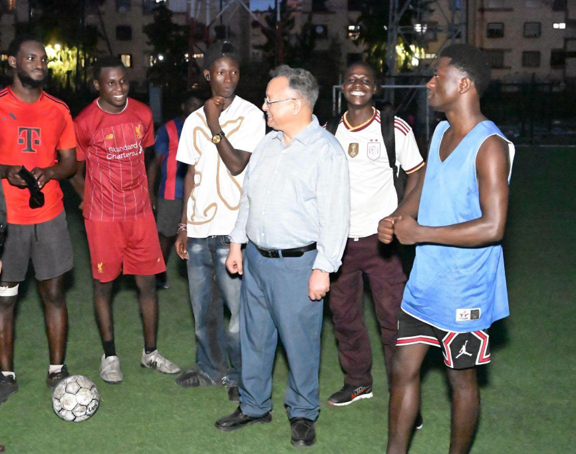
During the visit, Mr. Baddari met with several African international students residing at the university residence. He enquired about their living conditions and listened to their concerns. The students expressed their satisfaction with the accommodation conditions and the services provided to them.
The Minister also inspected the various facilities and equipment, stressing the need to continue efforts to improve the quality of university services and enhance the level of support provided to students, both Algerian and international, by ensuring a suitable university environment conducive to study and stability.

Mr. Kamel Baddari inspects the readiness of the Faculty of Economic Sciences at “Ibrahim Sultan Cheibout” Algiers 3 University.

activités ministérielles

Mr. Kamel Baddari inspects the readiness of the Faculty of Economic Sciences at “Ibrahim Sultan Cheibout” Algiers 3 University.

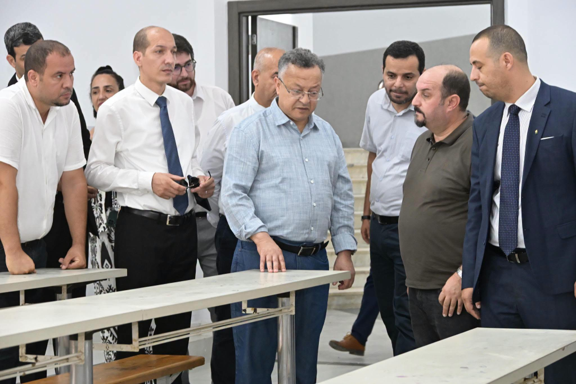
The Minister of Higher Education and Scientific Research, Mr. Kamel Baddari, conducted an inspection visit on the afternoon of September 17, 2026, to the Faculty of Economic Sciences of “Ibrahim Sultan Cheibout” Algiers 3 University, to assess its readiness to welcome students for the 2026–2027 academic year and to review its progress in joining the Fourth-Generation University (University 4.0) initiative.
During the visit, the Minister inspected the readiness of the various educational facilities and infrastructure, stressing the need to develop the university campus in line with current digital transformations, particularly through the establishment of Smart Spaces, thereby contributing to improving the quality of teaching and training and enhancing the services provided to students.
These orientations form part of the foundations of the transition towards University 4.0, with the aim of making the university environment smarter, more interactive and more connected, while keeping pace with the digital and technological transformations taking place in the higher education sector.
The Minister also inspected the construction site of a new project, whose works recently began, dedicated to hosting the headquarters of the hybrid education and continuing training platform, equipped with a Data Center. This ambitious project, which has received the approval and support of the General Directorate for Scientific Research and Technological Development (DGRSDT), is intended to establish an integrated environment for research, development and innovation. It will contribute to supporting the national economy, improving the quality of education and training, and strengthening the educational and training services provided to students.
In the same context, Mr. Baddari inspected the educational complex, which has undergone a comprehensive rehabilitation operation covering the library, faculty room, classrooms and lecture halls. The works have reached their final stages, paving the way for the complex to be ready to welcome students under the best possible conditions.
The Minister also inspected the readiness of the amphitheaters at the annex, particularly the “Soummam,” “17 October,” “Aurès,” “Revolution,” and “People” amphitheaters, to assess their preparedness to accommodate students as well as scientific and educational activities.
In the same context, the Minister inspected the readiness of the “Freedom” amphitheater, which has undergone a complete renovation and will officially enter service during the new academic year. It will host various scientific and cultural events organized by the faculty and the university.
The visit also included the annex library, which has likewise undergone a comprehensive rehabilitation and renovation operation, giving it a new appearance and providing students with a suitable environment for reading, study and scientific research, in line with the requirements of a modern university environment.

Minister of Higher Education and Scientific Research stresses, from Tipaza, the need to strengthen future-oriented fields and support entrepreneurship and innovation

activités ministérielles

Minister of Higher Education and Scientific Research stresses, from Tipaza, the need to strengthen future-oriented fields and support entrepreneurship and innovation

As part of the ongoing field monitoring of the readiness of higher education institutions to welcome students, the Minister of Higher Education and Scientific Research, Mr. Kamel Baddari, conducted a field visit to the university campus in Tipaza on Thursday, 10 September 2026. During the visit, he reviewed the level of preparedness of university facilities and infrastructure and was briefed on a number of projects and initiatives aimed at improving university performance and strengthening its role in serving national development.
During his meeting with the Rector and the management team of the “Morsli Abdullah” University of Tipaza, the Minister stressed the need to invest in excellence fields and future-oriented professions, particularly artificial intelligence, cybersecurity, renewable energy and biotechnology. This approach will contribute to developing qualified national skills capable of keeping pace with technological and economic transformations and strengthening the foundations of the country’s economic sovereignty.
The Minister also stressed that introducing English as a language of instruction in certain university programmes and fields is part of the response to the rapid transformations taking place in the global economy and the technological sector. This approach offers students broader prospects for entering the labour market, accessing global knowledge and strengthening their capacities in research and innovation.
The Minister noted that this orientation, supported by the university’s growing momentum in entrepreneurship and innovation, will contribute to strengthening the position of the University of Tipaza as a national hub for exchange and interaction, capable of attracting talent and projects and consolidating the university’s openness to its economic environment, thereby ensuring greater alignment between university education and the needs of the national economy.
In the same context, Mr. Kamel Baddari called for particular attention to be given to the startup hub, inaugurated in 2024 and dedicated to student entrepreneurs, as a vital space for hosting innovative economic projects, supporting students with ideas and projects, fostering a culture of initiative and entrepreneurship, and transforming knowledge and ideas into added value and wealth.
The Minister further stressed that, in light of current transformations, the University of Tipaza is called upon to move beyond its traditional role of transmitting knowledge towards becoming a producer of knowledge, a generator of innovation and an active partner in economic development. This would enable the university to contribute to job and wealth creation and to strengthening the knowledge-based economy.
These orientations are part of a new vision adopted by the University of Tipaza, which places future-oriented fields, artificial intelligence, digital transformation, English, entrepreneurship and innovation at the heart of its strategy as key levers for building a fourth-generation university capable of keeping pace with global transformations, responding to the needs of the national economy and contributing effectively to the achievement of national sustainable development objectives.