
activités ministérielles

The Finance Committee of the People’s National Assembly hears Mr. Kamel Baddari as part of the review of the 2023 Budget Settlement Bill

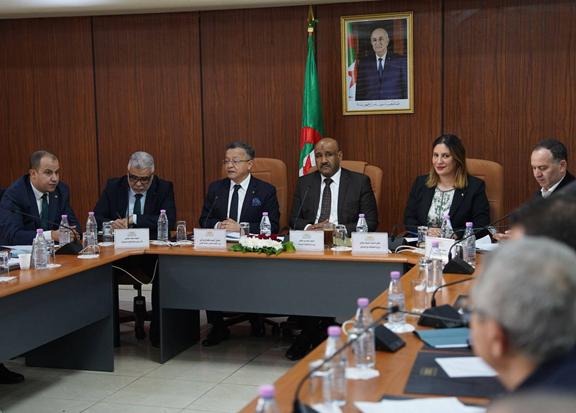
The Minister of Higher Education and Scientific Research, Mr. Kamel Baddari, took part on February 16, 2026, at the headquarters of the National People’s Assembly, in a meeting dedicated to examining the draft Budget Settlement Bill for the 2023 fiscal year, under the chairmanship of MP Mr. Mohamed Ben Hachem.

At the opening of the session, the Committee Chair emphasized that reviewing the 2023 Budget Settlement Bill represents a key step in assessing the financial performance of the higher education and scientific research sector, in a spirit of transparency and accountability.

In this context, Mr. Ben Hachem highlighted the scale of responsibility borne by the sector, particularly in ensuring stable human resource supervision, improving student conditions, monitoring investment projects, and developing pedagogical infrastructure. He stressed that the fundamental objective remains sound financial management and maintaining a balance between commitments undertaken and actual achievements, in the interest of students, the university community, and the advancement of scientific research.

For his part, the Minister explained that the preparation of the 2023 budget was carried out in line with public authorities’ directives on rationalizing public expenditure, given the prevailing economic conditions, with the introduction— for the first time—of program-based budget execution. He presented several key indicators, including:

Allocated commitment authorizations: 570,896,651,000.00 DZD

Commitment authorizations used: 511,758,460,445.84 DZD (consumption rate: 89.64%)

Allocated payment appropriations: 613,696,651,000.00 DZD

Committed payment appropriations: 511,766,051,568.81 DZD (83.39%)

Payment appropriations used: 511,758,460,445.89 DZD (83.39%)

During the discussions, Members of Parliament raised several key concerns, including:

  • Monitoring financial execution and the effectiveness of public spending, as well as reducing the gap between allocated and actually used funds.
  • Reviewing the consumption rate of payment appropriations allocated to university infrastructure projects and assessing their actual impact.
  • Evaluating the impact of digitalization policies on reducing administrative costs and redirecting savings toward supporting scientific research.
  • Orienting applied scientific research toward national strategic priorities, particularly food, water, and cultural security.
  • Enhancing the international visibility of Algerian universities and strengthening their academic standing.
  • Implementing the concept of the productive university and linking training to entrepreneurship, start-ups, and the national economy.
  • Monitoring patents and their effective transition to industrial production and economic exploitation.
  • Restructuring support for university services, including studying a gradual shift from in-kind support to direct financial assistance to rationalize expenditure.
  • Controlling operating expenses within the framework of public resource rationalization.
  • Lifting the freeze on certain investment projects and accelerating their implementation.
  • Strengthening the employability of university graduates and encouraging their access to entrepreneurship.
  • Improving the condition of university residences in terms of rehabilitation, re-equipment, accommodation conditions, and services.
  • Accelerating the completion of pedagogical infrastructure facing capacity pressure.
  • Expanding the network of the University of Continuing Education and progressively opening new centers in a structured and organized manner.