
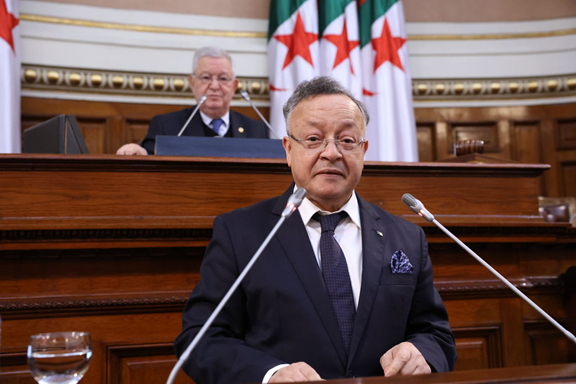
On 25 December 2025, Mr. Kamel Baddari, the minister of Higher Education and Scientific Research, attended a plenary session at the Council of the Nation, chaired by the Council’s president, Mr. Azouz Nasri. The session was dedicated to answering the oral questions from several government members. Four of these were directed at the sector and were asked by members of the Council of the Nation.
Mr. Lakhdar Moulay Saadoun: The mechanisms and priorities set by the Ministry for utilising scientific research to achieve sustainable development and national security in the country;
Mr. Youcef Laarab: The timeframe for providing buses to transport students from certain municipalities in the province of El Tarf to their university;
Mr. Abderraouf Fakhr Eddine Ghanem: The timeframe for registering the independent university centre in the province of Touggourt, as part of the national university development plan;
Mr. Miloud Kaddouri: The reasons that prevented the inclusion of the Nour El Bachir University Centre in El Bayadh among the centres that were promoted to university status, and whether the authorities will consider this request.
Mr. Baddari clarified that the Algerian university is committed to fulfilling its economic role. He stated that it “aims to be a genuine driver of national development, relying on knowledge-based and innovative economies.”
To align with the developmental vision outlined by the President of the Republic, Mr. Abdelmadjid Tebboune, for the period of 2024-2029, the university has included artificial intelligence, robotics, and all that relates to future professions into its training programmes. The minister adds that the scientific and technological hub of Sidi Abdellah offers specialisations in autonomous systems’ technology, applied mathematics, cybersecurity, nanoscience, and more.
The minister stated that all efforts are aimed at confirming that “Algeria has kept pace with developments occurring in higher education and scientific research internationally by training engineers in various specialities. The results of this training will become evident within 5 to 10 years.
Mr. Kamel Baddari recalled some of the research results recorded over the past two years: “3,249 patents, 310 start-ups, 2,611 student-run micro-entreprises, 430 subsidiaries across 117 university institutions, and 76 innovative projects oriented towards the economic sector.”
In addition, the higher education and scientific research sector has partnered with economic sectors such as agriculture through the production of feed and livestock breeding within the framework of smart agriculture.
In this regard, he revealed that “a new type of feed will soon be available in the national markets.” This was produced as part of the collaboration between the Desert Agriculture Research Centre and the agricultural sector.
Regarding the enhancement of semi-urban university transport services for students residing in districts and municipalities distant from the educational institutions in the province of El Tarf, it is important to note this category of student benefits from accommodation services at university residences without exception. Given the considerable availability of accommodation services at the directorate, the current situation does not require the establishment of semi-urban university transport. Nevertheless, 19 buses have been allocated for semi-urban transport this academic year.
As for the registration of a university centre project in the province of Touggourt, the sector does not oppose this initiative. However, it is essential to follow organisational procedures, which primarily begin with the accompanying university institution (the University of Ouargla), who must initiate the request once the project meets the necessary pedagogical, scientific and structural conditions. The proposed project will then be presented to the country’s higher authorities for approval.
On the subject of the promotion of the “Nour El Bachir” University Centre to university status, the sector will certainly support it in its evolution to university status, based on a study of its development project and its alignment with the established promotion criteria.