
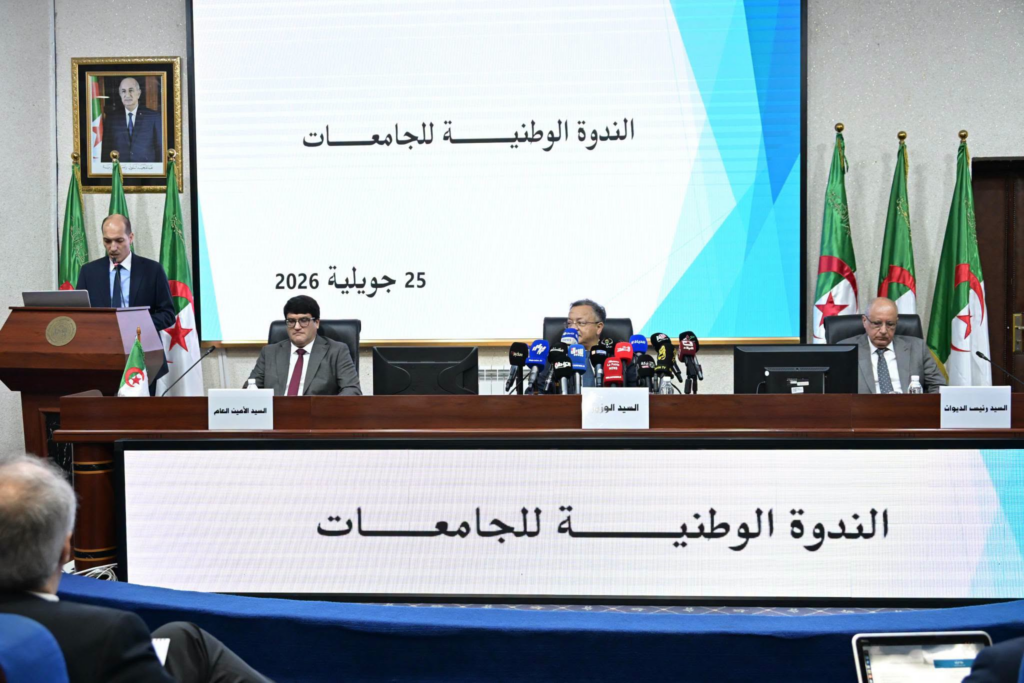
The Minister of Higher Education and Scientific Research, Mr. Kamel Baddari, chaired the National University Conference today, July 25, 2026. The conference was attended by senior officials from the central administration, presidents of regional conferences, directors of university institutions, directors of national organizations, as well as representatives of students and social partners in the sector.
In his opening address, the Minister affirmed that the Algerian university has entered a new phase, defined by the smart university, the entrepreneurial university, and the university as a producer of knowledge and wealth, in implementation of the orientations of the President of the Republic aimed at building a knowledge-based economy and strengthening scientific and technological sovereignty.
During the cpnference, the roadmap for the new academic year was presented. It includes a number of major structural projects, notably:
• The launch of a personalized educational pathway for students, supported by artificial intelligence technologies, through the introduction of a smart assistant that will guide students in selecting their courses according to their skills, interests, and academic and professional objectives, thereby enabling them to build a training pathway tailored to their ambitions and abilities.
• The development of a Large Language Model (LLM) for university professors, enabling them to automatically prepare exercises and educational activities, while also using artificial intelligence technologies to assess students’ answers. This will contribute to improving the quality of education and keeping pace with the latest teaching practices.
• As part of strengthening the university’s economic role, the Minister announced that the sector aims to bring 5,000 innovative Algerian products to the national market by 2030, under the slogan “Made in Algeria.” Each product is expected to lead to the creation of a startup, a micro-enterprise, or a spin-off, thereby transforming the university into a hub for production, innovation, and wealth creation.
• The second edition of the “Proto Market” programme was also announced. It will focus on supporting the development of technological prototypes, with funding ranging from one million (DZD 1,000,000) to two million (DZD 2,000,000) for students, enabling them to complete their final prototypes and obtain the “Startup” label.
• In the field of innovative project financing, the Minister confirmed the establishment of the first venture capital investment company at the University of Algiers 3, as well as the launch of Algeria’s first Venture Capital Mutual Fund (FCPR), with plans to establish four additional funds before the end of the year, in order to provide sustainable financing mechanisms for innovative student projects.
• The Minister also highlighted that Algerian universities are undertaking, for the first time, the process of obtaining the ISO 9001:2015 international quality certification. Five university institutions have already obtained the certification in the fields of education and scientific research, reflecting the sector’s commitment to promoting a culture of quality and continuous improvement.
• In the area of international engagement, the Minister called for increased efforts to improve the visibility of Algerian universities in international rankings, in light of the positive results achieved in recent years, and to further strengthen their scientific and academic presence internationally.
• The results of the university twinning programme were also presented, with a total of 77 twinning agreements, alongside the encouraging results achieved by the “Study in Algeria” platform, which has attracted 1,500 new international students from 34 countries. This contributes to enhancing the international standing of Algerian universities and generating significant foreign-currency revenues for the national economy.
• In the field of university services, significant progress has been recorded in improving students’ accommodation conditions, with 2,283 accommodation units renovated out of a total of 3,283. In addition, financial savings estimated at several billion dinars per month have been achieved since April through the digitalisation of catering services. This has directly contributed to rationalising expenditure, improving the quality of meals, and enhancing the quality of accommodation services provided to students.