
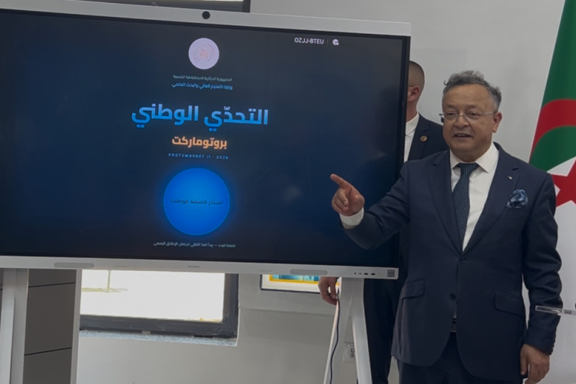
In a significant step towards promoting innovation and fostering an entrepreneurial culture within the university environment, the final deliberations of the second edition of the national challenge “ProtoMarket 2” resulted in the selection of 937 innovative projects for funding, out of a total of 2,110 applications submitted through the national platform. The total funding envelope amounts to DZD 1,188,400,000, with an estimated average of approximately DZD 1.27 million per project.
This initiative forms part of the efforts undertaken by the Ministry of Higher Education and Scientific Research to harness the innovative potential of students, graduates and doctoral students, and to support them in turning their creative ideas into prototypes that can be further developed, commercialized and economically valorized. It also aims to enhance the technological value of products emerging from universities and encourage the creation of start-ups, thereby helping transform knowledge and scientific research into innovative economic projects while opening up new opportunities for wealth creation and national development.
At the regional level, the selected projects are distributed across the country’s three regions. The Eastern region leads with 333 projects, followed by the Central region with 317 projects and the Western region with 287 projects.
This distribution reflects the broadening scope of participation and the growing momentum of innovation and entrepreneurship across national higher education institutions. It also highlights the diversity of the university innovation ecosystem and the increasing number of initiatives aimed at transforming creative ideas into projects with economic and technological value.
In terms of technological fields, the selected projects cover eight major areas. Digital applications and platforms rank first, with 314 projects, followed by artificial intelligence-based applications and platforms with 171 projects, electronic equipment and devices with 146 projects, and connected solutions and the Internet of Things (IoT) with 136 projects.
The selected projects also cover biological and food products; materials, chemistry and manufactured products; pharmaceutical, cosmetic and healthcare products; as well as services and training.
This diversity highlights the expanding scope of innovation within universities and the wide range of fields in which university talent applies scientific knowledge and technical expertise to develop innovative solutions that address economic and social needs. It also strengthens opportunities for technological valorization and the economic development of promising ideas and projects.
In terms of supervision and support, the results involve 98 university institutions out of 117 targeted university incubators. This reflects the broad reach of support and mentoring mechanisms designed for innovative projects and strengthens their prospects of progressing from the idea stage to practical implementation.
These results reaffirm the central role of university incubators as strategic platforms for hosting innovative initiatives, guiding project holders through the various stages of development, and enhancing their technological maturity, ultimately leading to the development of prototypes with potential for economic valorization and commercialization.
This momentum reflects the direction of Algerian universities towards fostering a culture of innovation and initiative, while strengthening the integration of education, scientific research and the requirements of economic and social development. It also demonstrates their commitment to transforming knowledge and creativity into added value by encouraging start-up creation, supporting a knowledge- and technology-based economy, contributing to wealth creation, and promoting sustainable national development.
As a reminder, ProtoMarket is a national mechanism designed to support and finance the development of innovative ideas into prototypes, paving the way for their further development into products suitable for manufacturing and commercialization. It therefore helps strengthen opportunities for valorizing university innovations and transforming them into projects with economic value, while encouraging start-up creation and fostering an entrepreneurial culture within the university environment.