
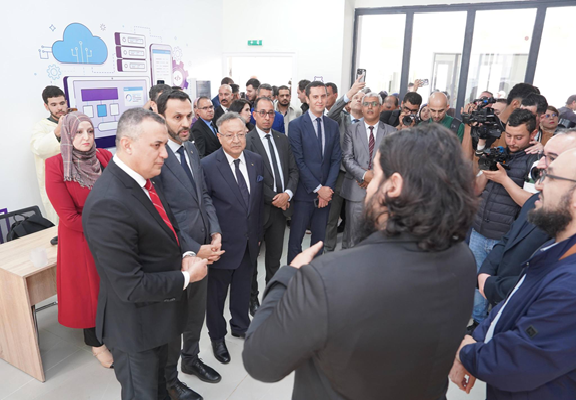
The Minister of Higher Education and Scientific Research, Mr. Kamel Baddari, along with the Minister of Knowledge Economy, Startups and Micro-enterprises, Mr. Noureddine Ouadah, and the Minister of Post and Telecommunications, Mr. Sid Ali Zerrouki, presided on April 18, 2026, at the “Martyr Abdelhafid Ihaddaden” Scientific and Technological Hub in Sidi Abdellah, over the launch of the first startup cluster in Algeria in the fields of artificial intelligence and cybersecurity.
This event represents a significant milestone in building a comprehensive national innovation ecosystem. It reflects the State’s new strategic direction aimed at structuring the innovative entrepreneurial landscape through clustering mechanisms, thereby enhancing startups’ competitiveness and their capacity to generate value.
The launch of this cluster also implements the provisions of the joint ministerial decree defining the modalities for establishing and organizing startup clusters. It further strengthens the integration between universities, scientific research, and the economic sector, aiming to accelerate the transformation of innovative projects into impactful businesses and to usher in a new phase of collaboration among stakeholders within the innovation ecosystem.
In a speech delivered on this occasion, Mr. Baddari stated that this “cluster” represents a practical mechanism for linking scientific research to the economy by creating direct interaction between various stakeholders, thereby enabling the transformation of knowledge into tangible economic value. He added that this space will enhance the attractiveness of Algerian universities and attract national talent both domestically and abroad, while also fostering a culture of innovation among students.
For his part, Mr. Ouadah explained that this project is the result of joint efforts with the higher education sector, noting that the legal and regulatory framework enabling the incubation of startups within universities has been finalized in recent months, including those originating outside the academic environment. He added that this initiative will allow students, teachers, and researchers to interact directly with economic stakeholders, while reaffirming the intention to generalize this model to all university institutions in the future.