
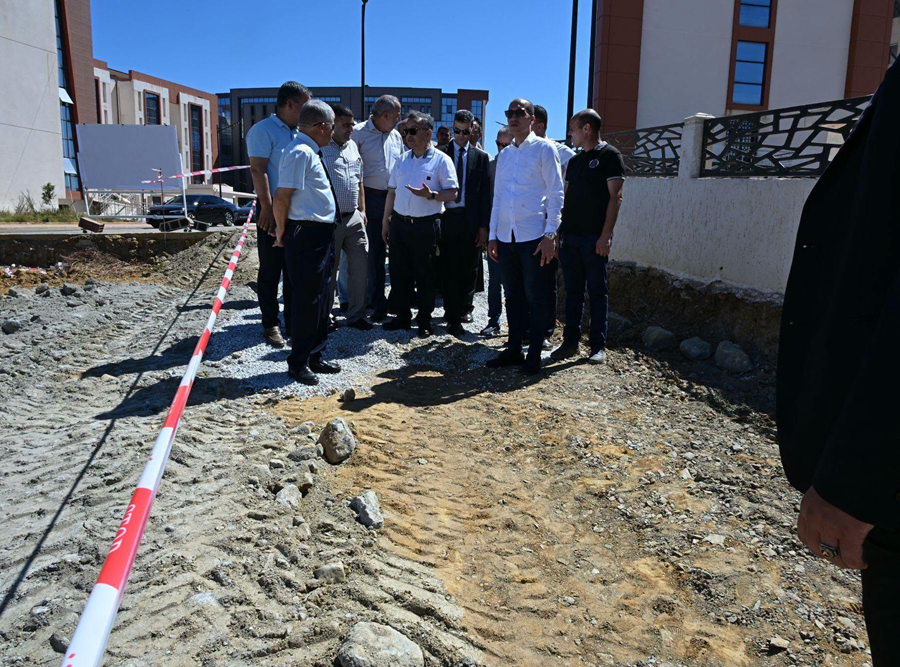
The Minister of Higher Education and Scientific Research, Mr. Kamel Baddari, conducted a field visit on the morning of Saturday, September 5, 2026, to «M’Hamed Bougara» University of Boumerdes, to assess the readiness of the Faculties of Medicine, Science and Engineering Sciences to welcome students for the 2026–2027 academic year, review teaching and reception conditions, and assess the availability of the facilities and requirements of a modern, smart university.
The visit is part of the continued implementation of the Strategic Development Plan for the Algerian University 2024–2029, translating it into concrete projects and programs and further strengthening the university’s role as a key partner in achieving national development objectives.
During the visit, the Minister issued a number of instructions aimed at improving teaching and reception conditions and upgrading university facilities in line with the requirements of University 4.0, based on digital transformation, innovation and artificial intelligence, while aligning academic training more closely with the needs of the national economy.
At the Faculty of Medicine, the Minister instructed that pedagogical facilities be upgraded and modernized, access points and the external surroundings of the faculty be improved, and classrooms, teaching spaces and various services be properly equipped. He also called for the introduction of solutions that would modernize and digitalize services and enhance the quality of student reception and guidance.
At the Faculty of Sciences, the Minister stressed the need to improve the faculty’s overall appearance, both inside and outside, and to enhance the university environment by developing and organizing its spaces, making them more attractive and better suited to the needs of students and teaching staff.
Regarding the Faculty of Engineering Sciences, the Minister instructed the university to develop and introduce new engineering and technology programs, particularly in areas related to light industries and advanced technologies, including microelectronics and microchips, mechatronics, computer hardware engineering, as well as embedded systems, automation and modern industrial technologies.
The Minister also called on the Rector to begin implementing the National Artificial Intelligence Strategy at the university level by developing specialized academic programs, promoting research and innovation in artificial intelligence, and leveraging AI applications to improve teaching and administrative performance as well as university services. This will further strengthen the university’s readiness for digital and technological transformation.
The Minister further emphasized the need to extend the operating hours of university facilities until 10:00 p.m. (22:00), thereby optimizing the use of infrastructure and equipment and providing students with additional spaces for studying, project work, research and innovation, within an organizational framework that ensures the proper functioning of university services.
In another area, the Minister stressed the importance of strengthening support for students in pursuing employment and self-employment opportunities through entrepreneurship training, incubation and project support, and by turning ideas and innovations into viable economic projects. This approach aims to help students move from being job seekers to creators of their own professional opportunities, while contributing to wealth and job creation.
These directives form part of an integrated vision that positions University 4.0 as a university that creates skills, innovation, employment and wealth, a driver of the implementation of the 2024–2029 Strategic Development Plan, and a platform for advancing digital transformation and artificial intelligence in support of the national economy.