
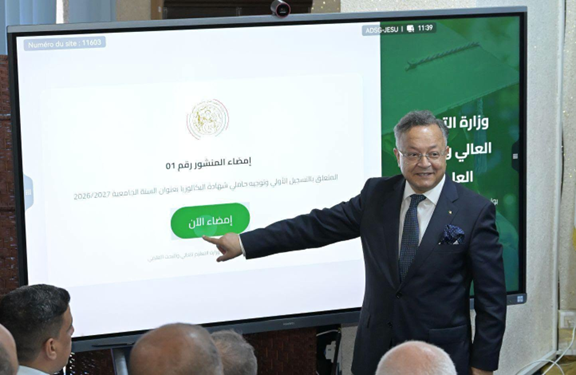
The Minister of Higher Education and Scientific Research, Mr. Kamel Baddari, officially launched the 2026 Baccalaureate Holders’ Orientation and Registration Guide on 7 July 2026 at the Ministry’s headquarters. In a new format, the circular reflects the sector’s vision aimed at building a digital, open, intelligent university that creates the professions of tomorrow, by consolidating digital transformation and modernizing the orientation and training system in order to meet the requirements of development and technological changes.
During a press conference devoted to presenting the content of Ministerial Circular No. 01 on the orientation and registration of 2026 baccalaureate holders, as well as the key features of the upcoming academic year, the Minister explained that the guide has been fully digitalised as an interactive online platform, enabling students to access all university orientation information and services easily and efficiently.
He announced that all registration procedures, whether academic or administrative, will be conducted exclusively online starting 15 July 2026, through dedicated digital platforms accessible via computers and smartphones, eliminating the need for physical attendance. A dedicated application will also be launched to allow new students to calculate their weighted average according to university admission criteria.
As part of the smart orientation initiative, the guide incorporates, for the first time, a Large Language Model (LLM) powered by artificial intelligence within the digital orientation platform. This feature enables students to ask questions and receive instant, personalised responses around the clock. In addition, data mining technologies will be used to analyse students’ preferences and optimise the orientation process. The number of programme choices available to applicants has also been increased from 10 to 12, providing greater flexibility in selecting academic pathways.
Regarding the development of academic programmes, the Minister announced the introduction of 13 new specialisations aligned with future professions, including a State Engineering programme in Artificial Intelligence, as part of the national objective of training 30,000 AI specialists by 2030. Other newly introduced programmes include an Integrated Master’s in Quantum Technologies, a Master’s in Information Systems Interoperability, and a Master’s in Space Systems Mechanics.
In coordination with the Ministry of Health, several new programmes in medicine and health sciences have also been introduced, including a Bachelor’s degree in Oral Health and Dental Hygiene, Master’s programmes in Genetic Counselling, Medical Artificial Intelligence, Medical Bioinformatics, and Addiction Studies, the opening of a Pharmacy programme at the University of Saïda, accreditation of a Master’s programme in Anaesthesia, and the creation of a Postgraduate Diploma in Precision Medicine.
The upcoming academic year will also strengthen programmes promoting national identity through the introduction of a programme in Information and Communication Sciences taught in the Amazigh language, specialising in audiovisual studies. Furthermore, the international dimension of higher education will be reinforced through six new programmes established under twinning agreements and partnerships with foreign universities, enhancing the national and international recognition of Algerian university degrees.
The Minister also announced several additional measures, including the enrolment of 35,000 new students in Higher Teacher Training Schools with direct employment contracts, the introduction of the Lean Start-up module into academic curricula, the upgrading of seven medical annexes into full faculties, increasing the total number of medical faculties to 21, the generalisation of the courses History of Algeria and Citizenship and Patriotism across all fields of study, and the integration of higher education institutions under the Ministry of Culture and Arts into the PROGRES digital information system.
In conclusion, Mr. Kamel Baddari reviewed the achievements of the previous academic year, which included the online launch of the National Qualifications Framework, the graduation—for the first time in the history of Algerian higher education—of a cohort of students who completed their entire academic journey without using paper, as well as the graduation of the first cohorts from the National Higher School of Mathematics and the National Higher School of Artificial Intelligence. These achievements demonstrate the rapid modernisation of Algerian higher education and reinforce its position as a digital, innovative, and internationally oriented university system.